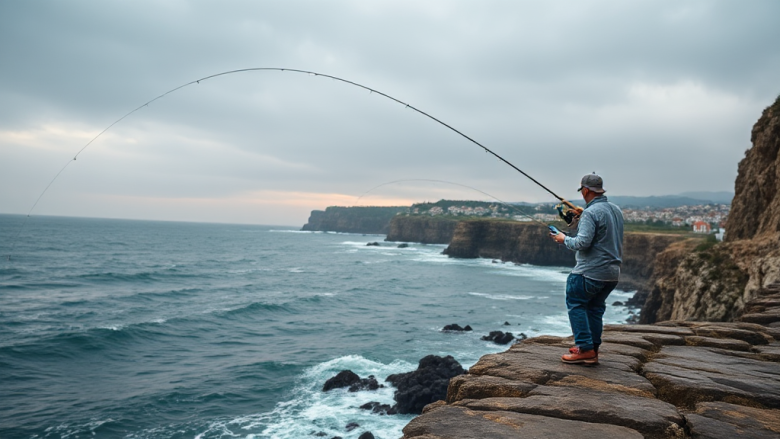
Three Minutes of Paperwork Before the Fishing in Portugal Actually Starts
Almost every write-up about angling on this coast spends its paragraphs on rods, tides and secret rock marks, and barely a line on the one thing that decides whether your first cast is legal: the licence. I learned that the hard way on a grey morning near Peniche, standing on a barnacled ledge with a rod already assembled while a maritime police officer explained, very patiently, that the piece of paper I had assumed was optional was in fact compulsory for anyone casting into salt water from shore. That conversation cost me a morning of prime fishing and taught me more than any tackle shop ever had.
So this is not a species list or a spot directory. It is the routine I now run every single time I plan fishing in portugal, written in the order it actually happens, with the costs and the value laid out honestly, because that is the part the glossy posts leave out.
What the Licence Actually Costs and What It Covers
The first thing to understand is that recreational sea angling from the shore in mainland Portugal is regulated, and the competent authority is DGRM. If you are fishing from a boat, from a beach, from a pier or from the rocks, you are generally in scope. Freshwater fishing runs under a different regime, which is exactly the kind of detail that catches visitors out, since a river mouth can look like the sea and behave like one until an inspector tells you otherwise.
What surprised me most, coming from countries where a rod licence costs the price of a decent reel, is how modest the Portuguese fee is. A short-term permit for a visiting angler is pocket change compared with a day of guided charter, and an annual option for residents works out cheaper still across a season. The value is not in the card itself. It is in the fact that you can stand on a jetty at six in the morning without that low background anxiety about a fine, a confiscated rod, or a ruined holiday. For the price of a couple of coffees and a pastel de nata, you buy the right to relax.
What it covers is recreational angling only. It does not license you to sell catch, to take undersized fish, or to ignore closed seasons and bag limits, which vary by species and are worth checking before you keep anything. The licence is permission to participate, not permission to do whatever you like. I keep a photo of the current rules on my phone alongside the permit itself, because the two belong together.
There is also the question people rarely ask out loud: does anyone actually check? In my experience, yes. I have been asked for documents twice in three years, once on a busy Algarve pier and once on a quiet stretch of the Vicentine coast where I genuinely believed I was alone. Both times the check took under a minute because I had everything ready. Both times I watched other anglers scramble. The enforcement is not theatrical, but it is real, and it tends to appear precisely where the fishing is good.
Getting the permit used to mean navigating a government portal in Portuguese, which is where most visitors gave up and simply risked it. That has changed. I now apply through a service that handles the DGRM recreational sea fishing licence for mainland Portugal, and the whole thing takes about three minutes: no NIF number, no wrestling with an unfamiliar interface, and payment by card, Apple Pay or Google Pay. I do it on my phone, usually the night before, sometimes in the car park while the kettle boils. You can see how that works here if you want to sort your fishing license before you travel rather than after you arrive.
One practical note on timing: apply before you need it, not on the morning you plan to fish. Mobile signal on the more dramatic stretches of coast is unreliable, and standing on a cliff trying to complete a payment while the tide turns is nobody’s idea of a good start.
My Actual Routine, From Booking Flights to First Cast
The routine has settled into something almost boring, which is the point. Roughly a week before I travel, I check the DGRM rules for the region I am visiting and note any species restrictions that have changed. Two or three days out, I apply for the permit and save the confirmation to my phone and to my email. The night before the first session, I check the tide tables and the swell forecast, because on this coast the difference between a pleasant morning and a dangerous one is often measured in metres of Atlantic swell rather than wind speed.
On the day itself, my kit is deliberately simple. A nine or ten foot spinning rod, a 4000-size reel, braid to a fluorocarbon leader, a handful of lures and a box of weights and hooks for bait fishing off the sand. I carry a small knife, a measuring tape and a wet cloth, because if I do keep a fish I want to do it properly and legally. I fish light because most of what I catch from the shore is modest in size, and heavy gear turns a decent fish into a dull fight.
The fishing itself follows a rhythm that took me a couple of trips to learn. Dawn and dusk outperform the middle of the day almost everywhere. Rocky headlands fish well on a rising tide with some wash, sandy beaches fish best in the troughs between bars, and harbour walls are forgiving when the ocean is angry. I move a lot. If a mark has produced nothing in forty minutes, I walk. The Portuguese coast rewards legs more than it rewards expensive tackle.
Safety is the part I refuse to be casual about. The Atlantic does not care how experienced you are. I never fish a low ledge alone, I never turn my back on the water to sort tackle, and I leave when the swell builds even if the fish are biting, because that is precisely when people get caught. I have watched a wave arrive at a spot that had been dry for an hour and take a bag, a rod and a good pair of shoes. It could have taken a person.
On cost, the honest accounting looks like this. The permit is a rounding error. Travel, accommodation and food dominate the budget. A guided trip, if you take one, costs more than a year of licences. The real value of sorting your paperwork properly is not the fee you pay; it is the sessions you do not lose, the fish you do not have confiscated, and the mornings you spend watching the water instead of explaining yourself to an officer. That is portugal fishing at its best: cheap to do legally, expensive to do carelessly.
What I would tell anyone starting out is to treat the licence as part of the tackle list rather than an afterthought. It takes minutes, it costs little, and it converts a nervous, half-legal session into a relaxed one. Everything else, the marks, the species, the perfect cast, comes with time on the water. The paperwork is the only part you can get right before you even leave the house, so get it right first, then go and enjoy the coast.